Relationships Poetry Anthology
Master the Edexcel Relationships Poetry Anthology with this comprehensive guide. We'll decode the poetic methods behind 15 diverse poems, helping you craft the perceptive, integrated comparisons that examiners reward at Level 6.
Study Notes
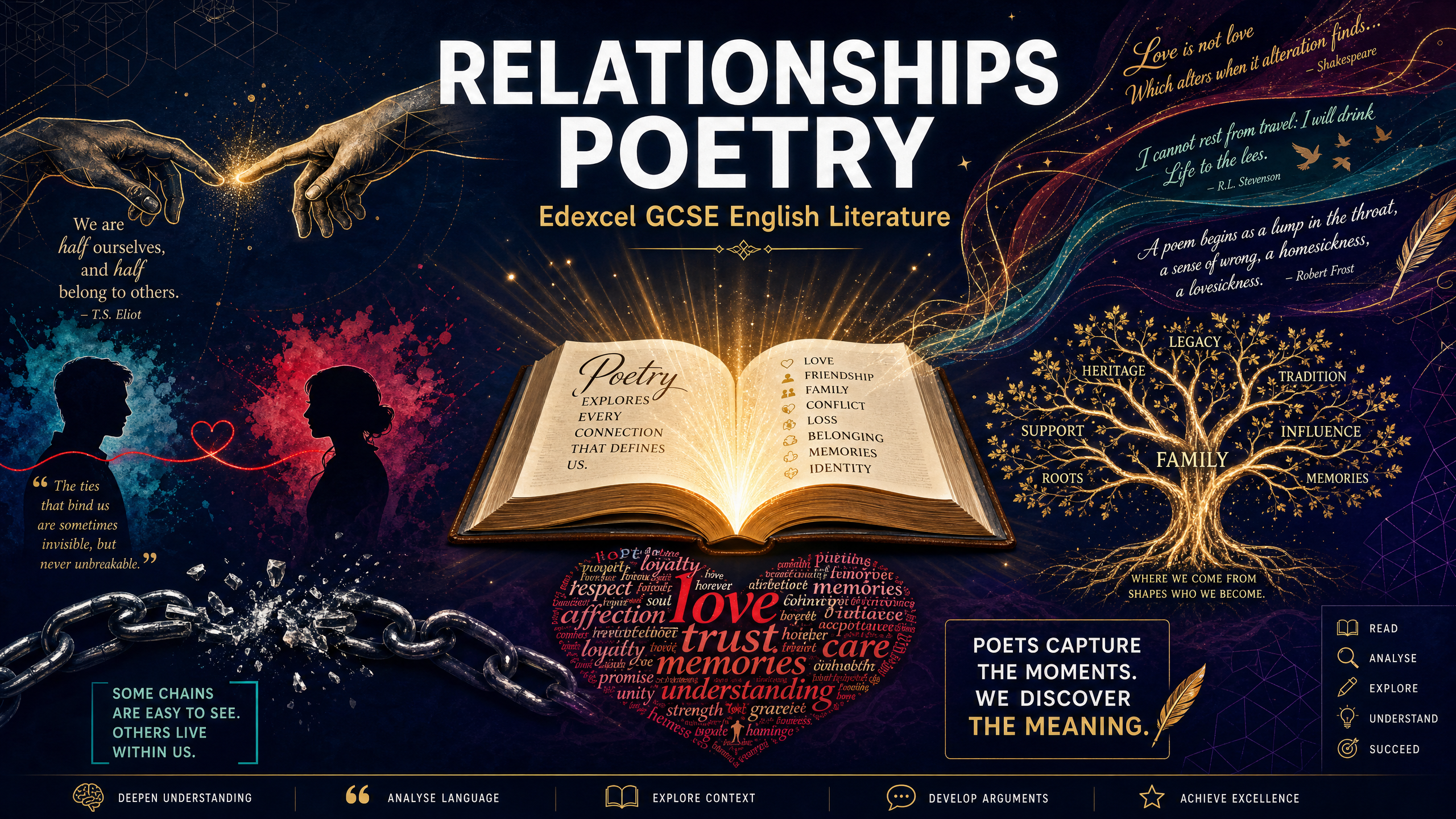
Overview
The Edexcel GCSE English Literature Relationships Poetry Anthology requires candidates to study 15 poems exploring human connections ranging from romantic love and familial bonds to the complexities of power, loss, and identity. For Paper 2, Section B, examiners are looking for perceptive comparisons between one named poem and another of your choice from the cluster. Success relies not merely on describing what the poems are about (AO1), but on critically analysing the poets' use of language, structure, and form (AO2), while seamlessly integrating relevant contextual factors (AO3). A strong response demonstrates a personal, conceptualised understanding of how different writers construct meaning.
Listen to our comprehensive audio guide for a deep dive into the anthology's themes and exam strategies:
Core Themes
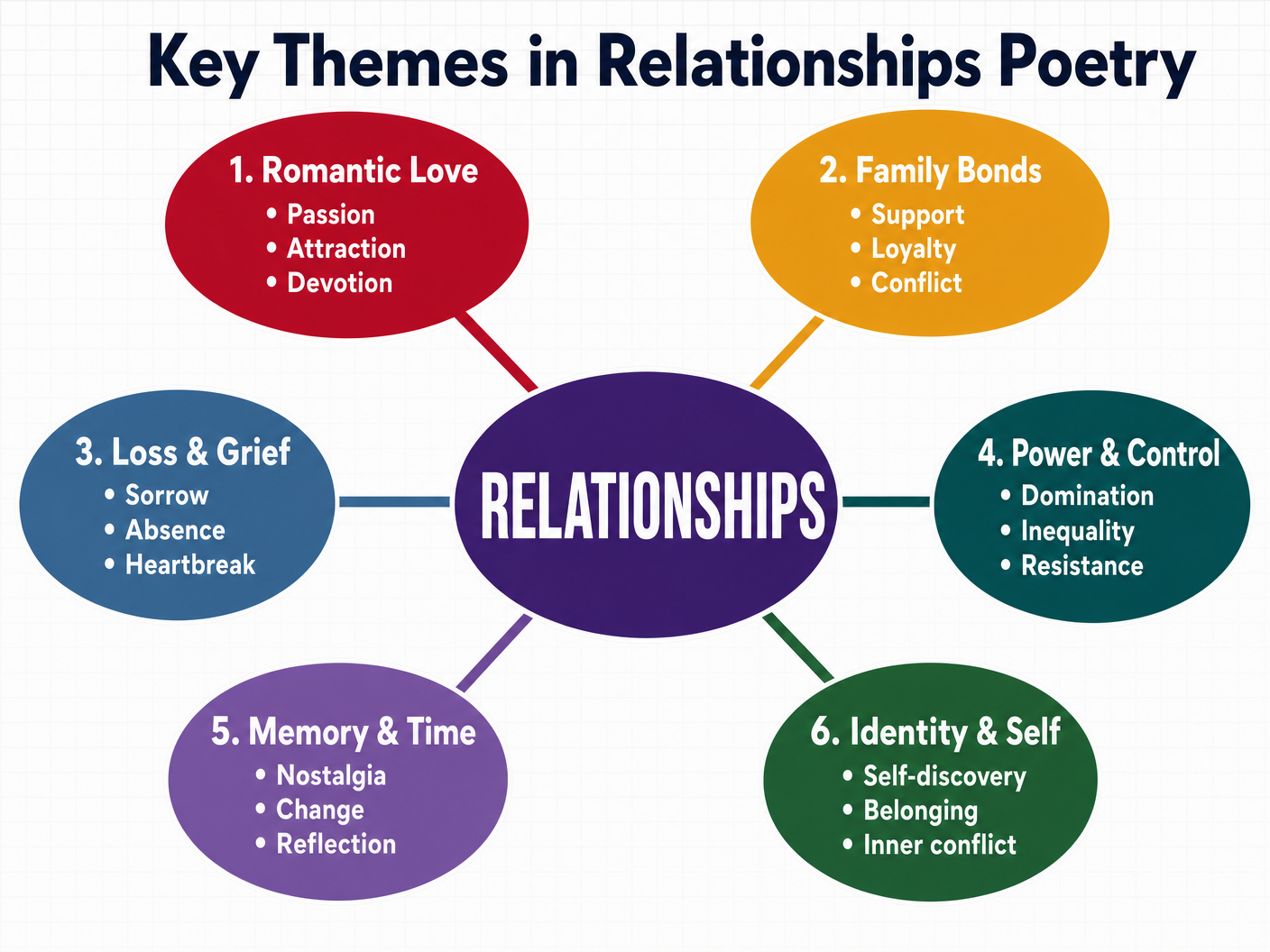
Theme 1: Romantic Love
Romantic love in the anthology is rarely straightforward; poets present it as passionate, enduring, but often fraught with vulnerability or imbalance. The presentation shifts from the idealised devotion of classical forms to the raw, sometimes painful realities of modern relationships. Candidates must analyse how extended metaphors and structural choices reflect these emotional states.
Key Quotes:
- "I love thee to the depth and breadth and height / My soul can reach" (Sonnet 43) - The spatial metaphor and enjambment convey a love that transcends physical boundaries.
- "We are half ourselves, and half belong to others." (General Anthology Concept) - Highlights the theme of intertwined identity.
Theme 2: Family Bonds
Family relationships are explored through lenses of inheritance, protection, and the inevitable distance that grows between parents and children. Examiners reward candidates who can link these personal poems to wider contextual ideas about cultural heritage and generational shifts.
Key Quotes:
- "I left it as a child / but my memory of it is sunlight-clear" (The Emigree) - The sensory imagery of 'sunlight' represents the unshakeable, idealised bond with the motherland/past.
- "A split second and you were away, intoxicated" (Walking Away) - The metaphor of intoxication captures the sudden, dizzying loss of parental control as a child seeks independence.
Theme 3: Power and Control
Some of the most complex poems deal with the darker side of relationships: domination, inequality, and toxic dynamics. When writing about power, candidates must pay close attention to structural dominance—who speaks, who is silent, and how form dictates control.
Key Quotes:
- "That's my last Duchess painted on the wall, / Looking as if she were alive." (My Last Duchess) - The possessive pronoun 'my' and the controlling dramatic monologue form immediately establish the Duke's oppressive power.
- "I gave commands; / Then all smiles stopped together." (My Last Duchess) - The chilling euphemism and abrupt caesura highlight the brutal finality of his control.
Writer's Methods
To achieve Level 5/6, candidates must move beyond feature-spotting and analyse the effect of specific methods.
Language: Poets use extended metaphors, sensory imagery, and precise diction to construct relationships. For instance, using aggressive, militaristic language to describe a romantic breakup reframes love as a conflict.
Structure: The arrangement of ideas is crucial. Enjambment can suggest a flow of uncontrollable emotion or the breaking of boundaries, while a sudden caesura often mirrors a fracture in a relationship or a moment of hesitation.
Form: The choice of form carries inherent meaning. A Petrarchan sonnet brings expectations of idealised courtly love; if a modern poet uses it to describe a toxic relationship, that subversion of form is a key analytical point for AO2.
Context (AO3)
Context is not a history lesson; it is the environment that shapes the text. Examiners penalise 'bolted-on' context. Instead, weave it in. For example, do not just state that Browning wrote in the Victorian era. Explain that Browning uses the Renaissance setting of 'My Last Duchess' to critique the patriarchal control and objectification of women prevalent in his own Victorian society, demonstrating how relationships are shaped by systemic power imbalances.
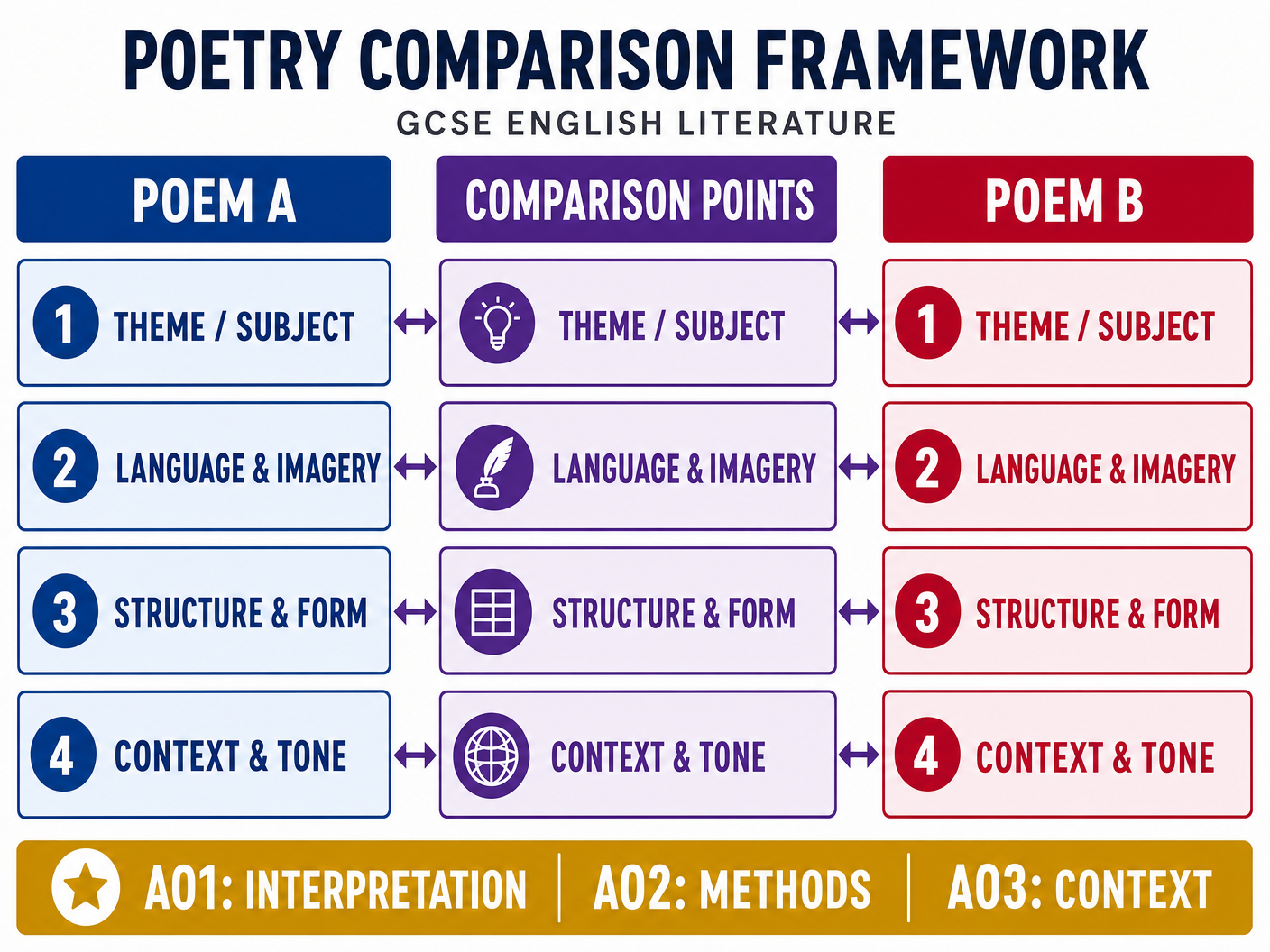
Visual Resources
2 diagrams and illustrations
Interactive Diagrams
1 interactive diagram to visualise key concepts
Conceptual Flow Outline
The Poetry Comparison Planning Process
Worked Examples
2 detailed examples with solutions and examiner commentary
Practice Questions
Test your understanding — click to reveal model answers
Compare how poets present the effects of time on relationships in 'Walking Away' and one other poem from the anthology. (20 marks)
Hint: Consider how time brings necessary separation in 'Walking Away', and contrast this with a poem where time brings bitterness (e.g., 'Neutral Tones') or deepens love.
Compare how poets present intense emotion in 'Sonnet 43' and one other poem. (20 marks)
Hint: Look for a poem that also deals with overwhelming feeling. You could choose another romantic poem for similarities, or a poem about intense grief or anger for contrast.
Compare how poets explore the theme of memory in 'The Emigree' and one other poem. (20 marks)
Hint: Focus on whether memory is presented as reliable or distorted, comforting or painful.
Compare how poets present complex family relationships in 'Walking Away' and one other poem. (20 marks)
Hint: Look at the tension between holding on and letting go.